POP reading & problem writing
Read the foundations, then use them to write a problem statement, an analysis, and an assessment that another agency can learn from.
How to write a problem
Use this reading path alongside the downloadable report template. These prompts are an editorial synthesis; each step links to its supporting sources.
1. Establish that this is a problem
2. Write a precise problem statement
3. Build an analysis narrative
4. Explain the response rationale
5. Write an assessment that can be checked
6. Assemble the project report
7. Review the weak points
Herman Goldstein’s writings
The founding works, Madison studies, background writings, and interviews. Repository records keep their stable item links.
Goldstein’s founding article argues for organizing police work around recurring substantive problems and examining whether responses reduce harm.
Read source details
A book-length account of identifying, analyzing, responding to, and assessing policing problems, including the organizational changes POP requires.
Read source details
Goldstein revisits the development and adoption of POP in his 2018 Stockholm Prize lecture and connects it to policing in a democratic society.
Read source details
An examination of the barriers to developing POP and a proposal for strengthening knowledge about particular policing problems.
Read source details
A concise statement of the principles that distinguish problem-oriented policing and guide its practice.
Read source details
A study of theft from vehicles in city-center parking facilities and the lessons from a problem-oriented response.
Read source details
A problem-oriented construction-site theft project, with attention to prevention and lessons for future projects.
Read source details
Samuel Walker interviews Herman Goldstein about his career and the development of problem-oriented policing in nine video segments.
Read source details
The first Madison project report introduces the problem-oriented approach to improving police service.
Read source details
The Madison study examines drinking-driving as a community problem and reviews the responses available to police and their partners.
Read source details
A Madison study of repeat sexual offending, part of the early development of problem-oriented policing.
Read source details
The fourth Madison report reflects on experimenting with a problem-oriented approach to improving police service.
Read source details
Goldstein examines the potential of community-oriented policing and the requirements and questions that accompany it.
Read source details
An NIJ Research in Brief report on the complexity of policing and the implications for reform.
Read source details
A chapter examining the varied demands on police and the tensions involved in exercising discretion.
Read source details
Goldstein examines police functions, discretion, accountability, and reform in a democratic society.
Read source details
Background reading on the police responsibilities that extend beyond preventing and controlling crime.
Read source details
An early proposal for using explicit police policy to improve performance and guide discretion.
Read source details
An early examination of how the police function should be understood and defined.
Read source details
An account of increased sanctions on drinking drivers in Madison, useful alongside the earlier Madison problem-oriented study.
Read source details
An oral history of Goldstein’s career, available through the University of Wisconsin repository as a transcript and audio.
Read source details
A chapter connecting POP with environmental criminology. The repository restricts full-text access and records a conflicting publication date; consult the publisher’s edition when citing.
Citation onlyRead source detailsProblem solving and report writing
Analysis manuals, practical guidance, teaching materials, and the Newport News demonstration report.
The revised 2016 edition of Clarke and Eck’s practical guide to defining problems, analyzing patterns, choosing responses, and assessing results.
Read source details
The Newport News demonstration report documents problem-oriented police work and the scanning, analysis, response, and assessment process.
Read source details
The official requirements and judging criteria for a Goldstein Award project report, including its SARA summary, narrative, and appendices.
Read source details
Use Community, Harm, Expectation, Events, Recurrence, and Similarity to test whether a set of incidents forms a policing problem.
Read source details
The UK predecessor to 60 Small Steps, using British examples to develop practical problem-solving crime analysis.
Read source details
A practical guide to using analysis throughout a law enforcement problem-solving project.
Read source details
A COPS Office field guide to identifying problems and organizing problem-solving partnerships.
Read source details
A guide to problem analysis as a discipline and its role in police problem solving.
Read source details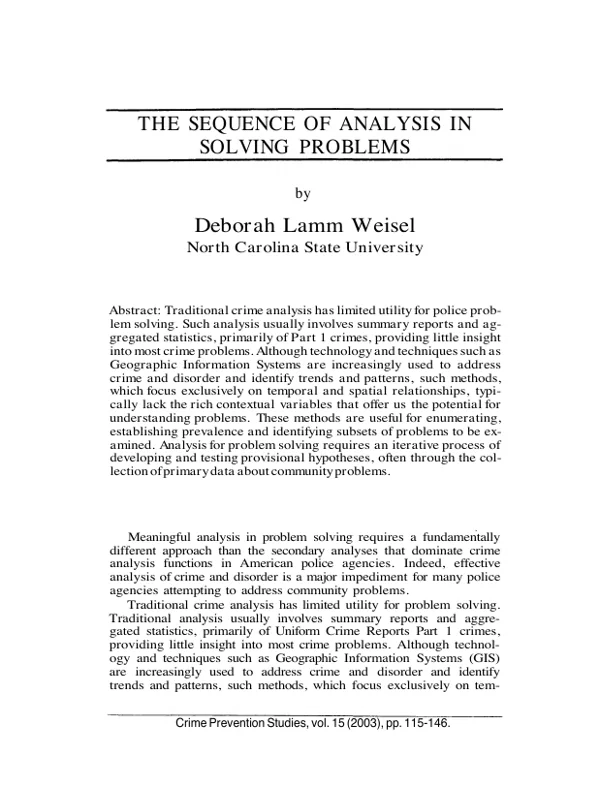
Weisel explains how to organize an analysis around questions and hypotheses that can inform a response.
Read source details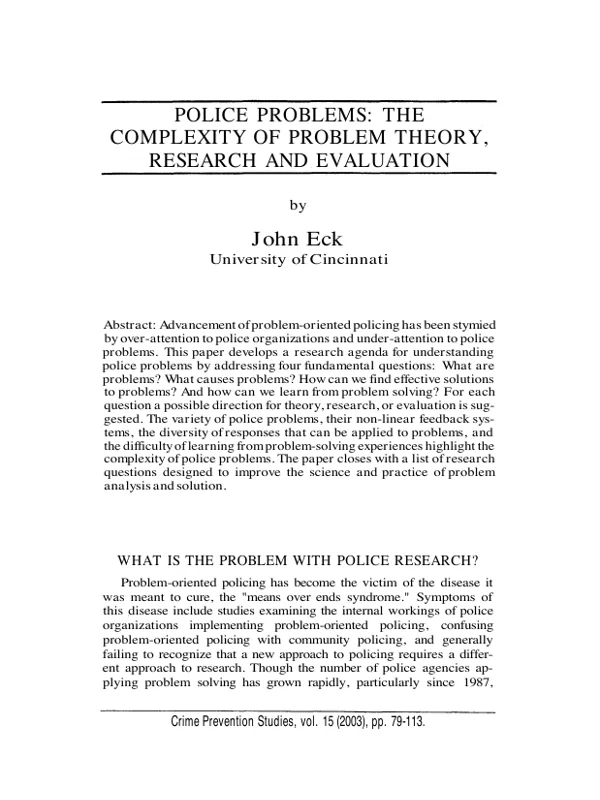
Eck examines the complexity of policing problems and what it means for theory, research, and evaluation.
Read source details
Scott considers the organizational and practical changes needed for police to take POP seriously.
Read source details
A review of POP’s first two decades, including its development, implementation, and recurring challenges.
Read source details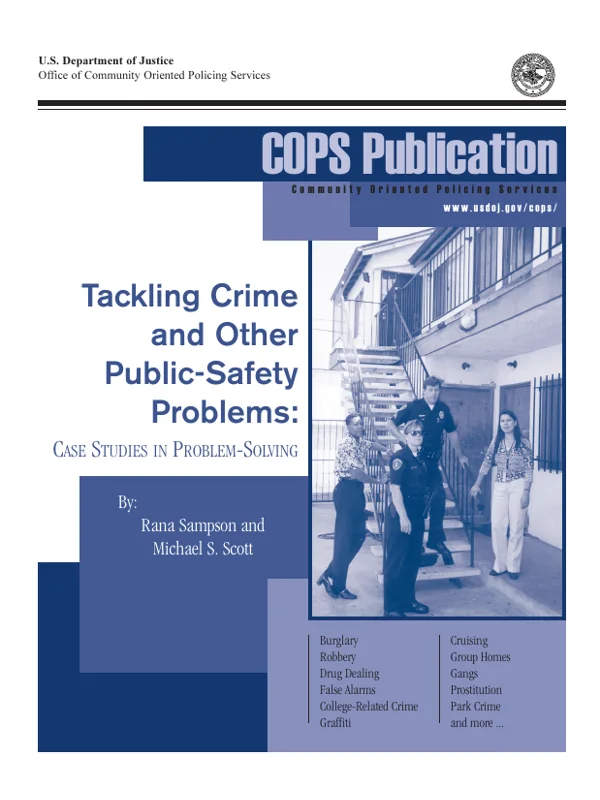
A collection of problem-oriented case studies illustrating how agencies investigate and respond to public-safety problems.
Read source details
A Home Office study of weaknesses in problem solving and the implications for crime reduction practice.
Read source details
Clarke examines the contribution criminology can make to POP and situational crime prevention.
Read source details
A practitioner handbook covering problem definition, analysis, responses, evaluation, and community engagement.
Read source details
A fourteen-module teaching sequence for learning and delivering problem-oriented policing.
Read source details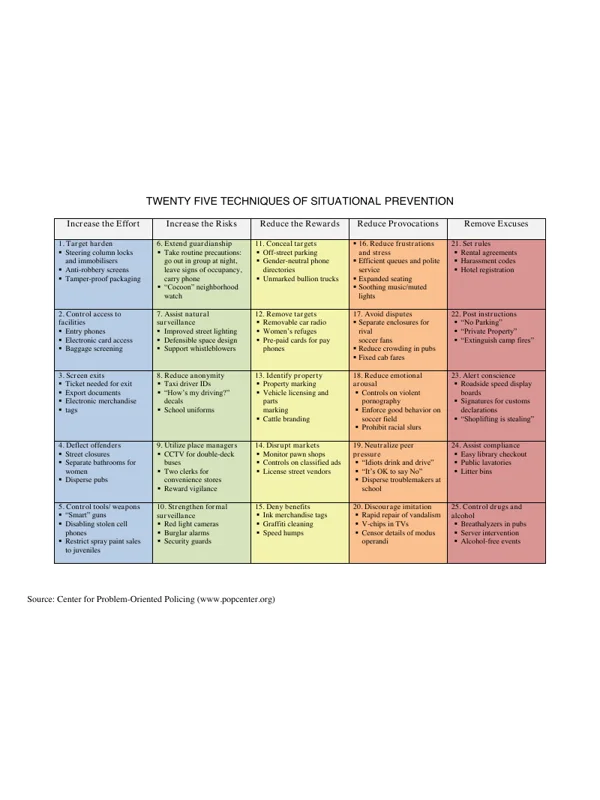
A reference sheet organizing situational prevention techniques to help develop a response to an analyzed problem.
Read source detailsEvidence and further reading
The Campbell review, implementation studies, and the Crime Prevention Studies index. Access varies by publication.
An updated Campbell systematic review and meta-analysis of POP interventions intended to reduce crime and disorder.
Read source details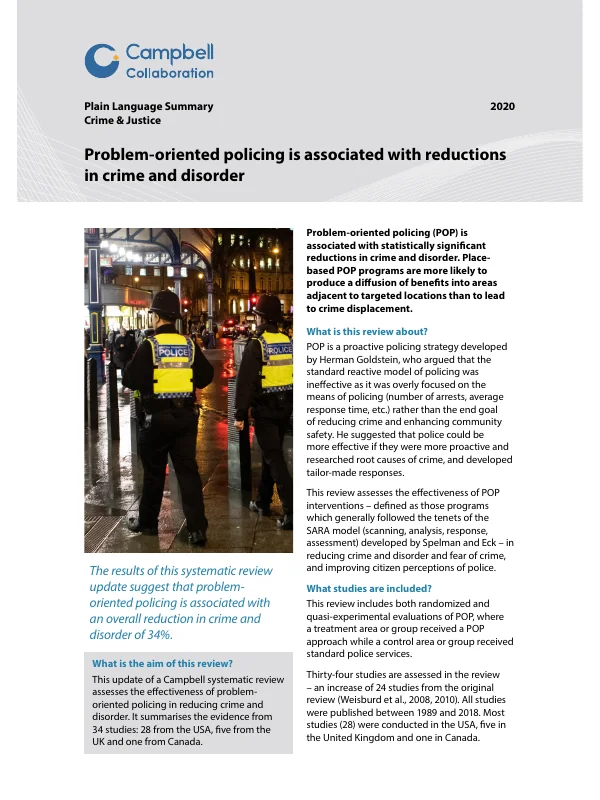
A practitioner-oriented summary of the findings and implications of the 2020 Campbell systematic review of POP.
Read source details
An annotated reading list of studies examining the implementation of problem-oriented policing.
Read source details
The official index to 28 Crime Prevention Studies volumes. Volumes 1–15 offer full text; later volumes provide contents, introductory chapters, and abstracts where available.
Read source details
A collection of modern POP case studies edited by Michael S. Scott and Ronald V. Clarke. Publisher citation; the book is not provided as free full text.
Citation onlyRead source detailsRead award projects with a writer’s eye
The 2025 co-winners offer complete SARA accounts to read alongside the template. Examine how each defines its problem and supports its assessment; an award is not an independent evaluation of every claim.
- Leicester: violence around McDonald’s restaurants — follow the problem definition into the analysis of place and the night-time economy, then examine the assessment.
- The Pōneke Promise: Te Aro Park — compare the account of the park’s problems with the response and the evidence presented for change.
Award status and submissions: ASU POP Center’s 2025 archive.